AI coordination assistant for volunteer matching and outreach.
This was my final class project for a Generative AI course, where the assignment was to design and build an assistant. For this project, I picked a local NGO, Northbridge, to help them facilitate volunteer search for local volunteering programs.
Northbridge relied on manual, spreadsheet-driven volunteer coordination across tutoring, pantry operations, environmental projects, and community events. Program managers had to search across volunteer profiles, skills, certifications, availability, and scheduling constraints to identify appropriate matches, making coordination slow and difficult to scale.
I owned the project from product narrative to working prototype, defining the assistant’s role, designing the coordinator workflow, shaping the matching logic, setting guardrails, and building the demo experience. I used GenAI as a build partner while applying class concepts around grounding, structured outputs, human oversight, and policy-aligned AI behavior.
Problem
How might Northbridge help program managers quickly identify qualified, available volunteers while enforcing certification rules and reducing manual coordination work?
Outcome
Designed and built an AI-assisted volunteer coordination prototype that reduced volunteer search time by over 90%, moving coordinators from manual spreadsheet filtering to ranked, rule-based matches with draft outreach for review.
From class prompt to AI prototype in 3 weeks
I’m proud of this project because it was my first time moving from an AI product concept into a coded prototype. I started with a class prompt, volunteer CSV data, and communication guidelines, then turned them into a working assistant concept for volunteer matching and outreach.
Phase 1: Product framing and workflow design
Worked through the project prompt, volunteer CSV data, NGO communication guidelines, volunteer coordination rules, required hours, program needs, and email templates to understand the operational problem. From there, I framed the coordinator workflow and defined what the assistant should interpret, recommend, and leave for human review.
Phase 2: Matching logic and structured data
Worked with volunteer data, request requirements, certification rules, availability, and scheduling constraints to design the logic behind eligible matches and recommendation explanations.
Phase 3: Prototype build and demo
Used GenAI as a coding partner to build the assistant flow, test recommendation outputs, and create a demo showing how program managers could move from a staffing need to ranked matches and draft outreach.
What the assistant was designed to do
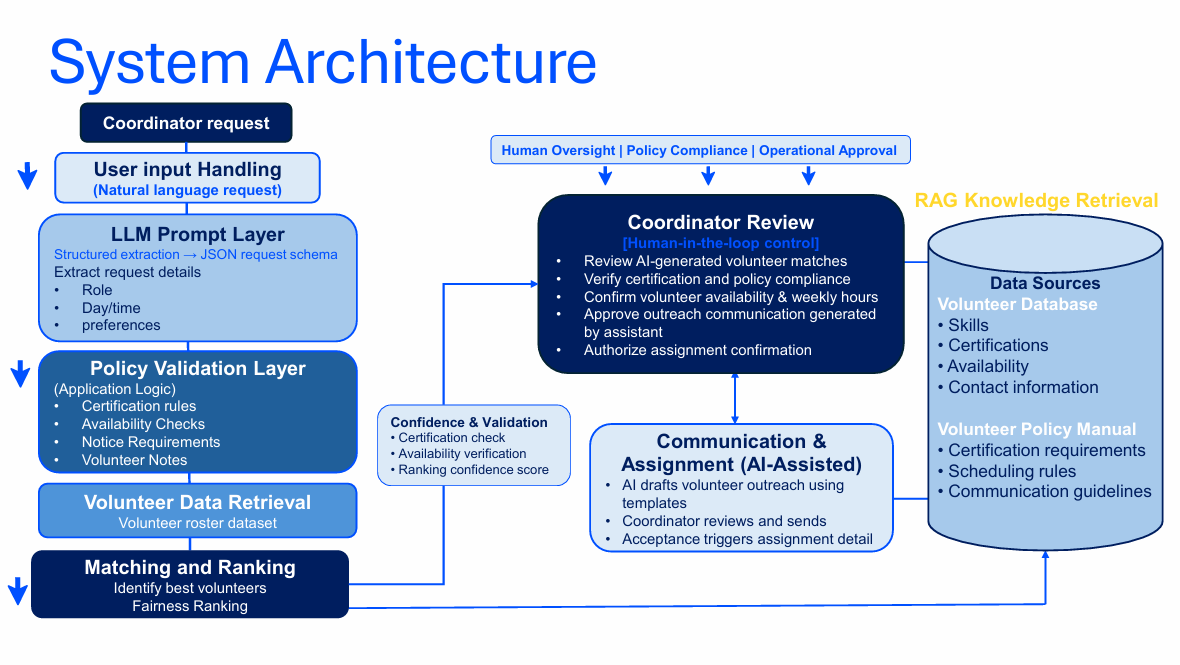
Natural-language request intake
Coordinators can describe a volunteer need in plain language, including the role, timing, preferences, and required qualifications.
Eligibility and policy checks
The assistant checks certifications, availability, notice requirements, volunteer notes, and policy constraints before recommending matches.
Ranked volunteer recommendations
Eligible volunteers are ranked based on role fit, availability, policy compliance, and fairness logic such as least-recent assignment.
Outreach and assignment drafts
The assistant drafts policy-aligned outreach and confirmation messages that a coordinator can review before sending.
Building the prototype without a coding background
This project was my first time coding an AI product prototype. I used GenAI to help translate product requirements into code, but the most important work was deciding how the assistant should behave: what data it needed, how volunteer matches should be ranked, what constraints mattered, and where human approval was required.
Working through the build helped me understand that AI product work is not only about prompting. It is about system design, structured data, guardrails, workflow clarity, and making the output trustworthy enough for someone to use.
Takeaway
This project taught me that building with AI requires both product judgment and technical curiosity. The assistant was only useful once the user need, data structure, matching rules, communication flow, and human review points were clearly defined. That was the biggest shift for me: moving from “AI can answer a question” to “AI can support a real operational decision when the workflow is designed well.”
Prototype walkthrough
This prototype screen shows how the assistant supports volunteer coordination by interpreting staffing needs, checking constraints, returning ranked matches, and preparing coordinator-reviewed outreach.
View walkthrough